
 20. 05. 2026
Zaida Saiace
 New, Performers, Albums Tango
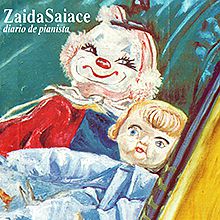 A pianist’s diary from Buenos Aires
Zaida Saiace may be a familiar name to some. The Argentine pianist lived in Germany for many years and has also performed regularly in other European countries. Her first recordings date back to the 1990s. At that time, she interpreted classical music in the form of a diary. “Diario de Pianista” was recorded in Argentina in 1992, “Diario de Pianista II” in 1996 in France. The album “Tango Novelle”, as the name suggests, features tangos and was recorded between 2001 and 2006 in Germany, Argentina, and Switzerland. All three albums are now available through “Danza y Movimiento”. By clicking on the album links, you’ll be taken to the respective track, and from there you can also select a platform where you can listen to or purchase the entire album.
A note for collectors: You can get all of our releases in uncompressed FLAC format at the “Qobuz” stores: https://www.qobuz.com/.*
And if you’d like to learn more about Zaida, you can find additional information in the section of our “Music Publishing”.
15. 02. 2026
Osvaldo Fresedo 1924 to 1926
Classic, Orchestra, Audio quality, Series, Albums Tango
 Osvaldo Fresedo 1924 to 1926
During this recording period, the sextet “Orquesta Típica Fresedo,” which later became famous, under the direction of Osvaldo Fresedo on the bandoneon, underwent a personnel and stylistic reorganisation and, with the change from the former record company Victor to Nacional Odeón, also a reorganisation in terms of distribution.
There were certainly some highlights during this period, but income continued to be generated more from sheet music sales than from record sales. The acoustic recording technology using a funnel was simply still too rudimentary for a real music distribution business to be successful.
15. 02. 2026
Cobian 1923 and de Caro 1924 to 1926
Classic, Orchestra, Audio quality, Series, Albums Tango
 Cobian 1923 and de Caro 1924 to 1926
In this series of recordings, whose speed has been carefully researched and adjusted to match the era, we present six albums by Juan Carlos Cobian and Julio de Caro from the time before the invention of the electric microphone.
Cobián himself did not record very much. The two albums from 1923 stand alone. Cobián founded this orchestra after leaving Osvaldo Fresedo. Among others, violinist Agesilao Ferrazzano and Luis Petrucelli on bandoneon are featured. Both had also previously played with Fresedo. Pedro Maffia (bandoneon) is also featured. And the second violin is played by none other than Julio De Caro! In this respect, the 1923 OT Cobían can be seen as the direct predecessor of the OT De Caro.
18. 02. 2025
The early years of Osvaldo Fresedo
Classic, Orchestra, Audio quality, Series, Albums Tango
 Nine albums dealing exclusively with the early recordings of Osvaldo Fresedo are currently being released. For the first time in more than 100 years, some of his music is been made available for dancing again. In addition, the careful sound processing and adaptation to the speed at which this music was recorded in the 1920s has created a sublime listening and dancing experience.
It all began with the Orquesta Tipica Vicente Loduca in 1917, when a dance orchestra with Fresedo and his bandoneon and Francisco Canaro on violin set the trend for everything that happened later in tango. The Loduca album (see below) contains all the recordings currently known of Fresedo with this orchestra.
After a trip to the New York music scene, Fresedo received a contract with the Victor label in 1922 and began performing with his own orchestra and recording in the studio. There was no electric microphone at the time. Its predecessor was a funnel, which is why it is also referred to as an acoustic recording.